
Wireless Networks
Wireless or Wi-Fi, What Is It? And What’s the Difference?

We use wireless networks every day, but how does it actually work when we connect to our home or work network?
Wi-Fi is a standard that provides rules and specifications so that manufacturers can make equipment compatible with already-manufactured devices. It allows phones, tablets, or laptops to connect and establish communication with other devices. All Wi-Fi equipment is wireless, but not all wireless devices are Wi-Fi. Therefore, any connection that isn’t made through cables and whose purpose is exchanging information can be called wireless. For example: Bluetooth keyboards, wireless printers, infrared remote controls. All of these are forms of wireless connection.
Information is exchanged through electromagnetic radio waves that are able to propagate through the air. These waves are formed by the combination of electric and magnetic fields; through these waves it’s possible to watch TV, access the internet, listen to music, and even cook food in the microwave. In the following image we can see how radio waves work, ranging from low waves all the way to gamma rays. You can see that each frequency range is dedicated to a certain type of service. For example, in the case of Wi-Fi, it works at the frequencies 2.4GHz and 5GHz, but Bluetooth and microwaves also work at this same frequency, which can cause interference between them.
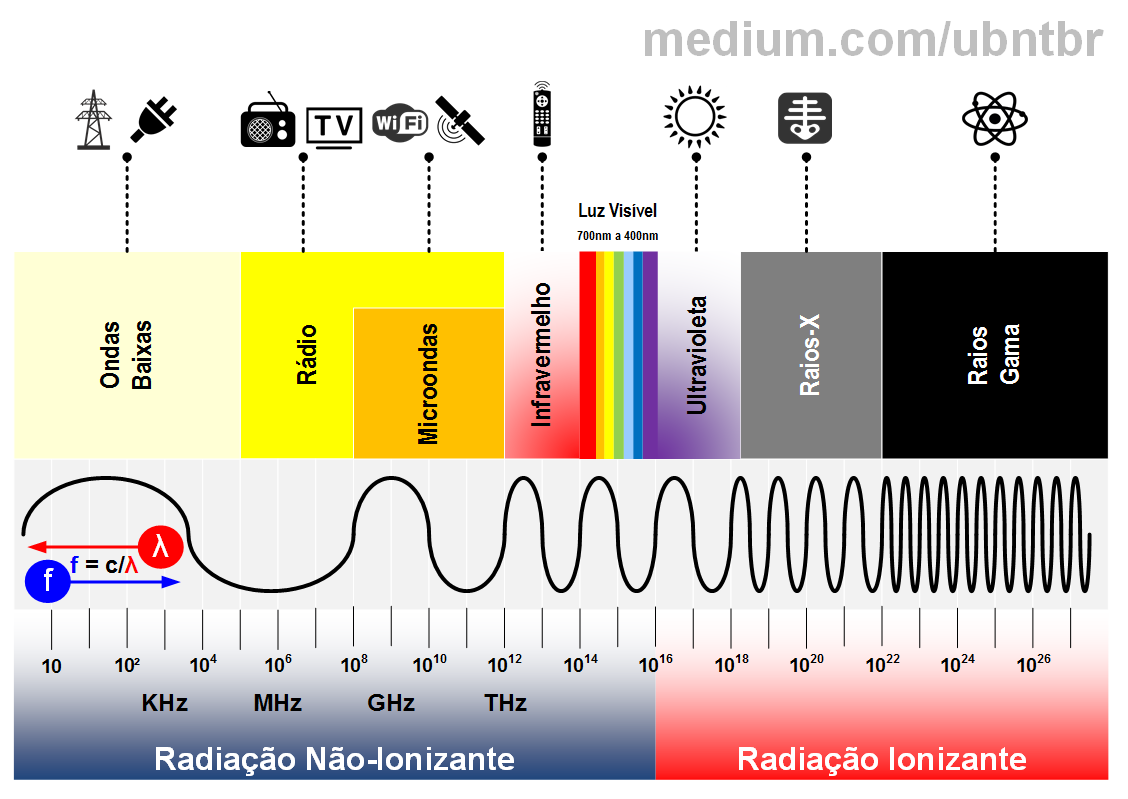
Source: (UbntBR) – https://medium.com/ubntbr
Most Wi-Fi equipment works at the 2.4GHz frequency, which can cause slowdown issues due to contention for the medium. However, equipment that operates in the 5GHz band is becoming increasingly common, which has expanded the adoption of wireless networks for high-performance environments.
2.4 or 5GHz?
When choosing a wireless access point, it’s important to pay attention to the operating frequency. In the case of 2.4GHz, wider signal coverage is a plus, but the connection speed is lower; in the 5GHz standard, on the other hand, it’s possible to reach higher speeds, but with a shorter range.
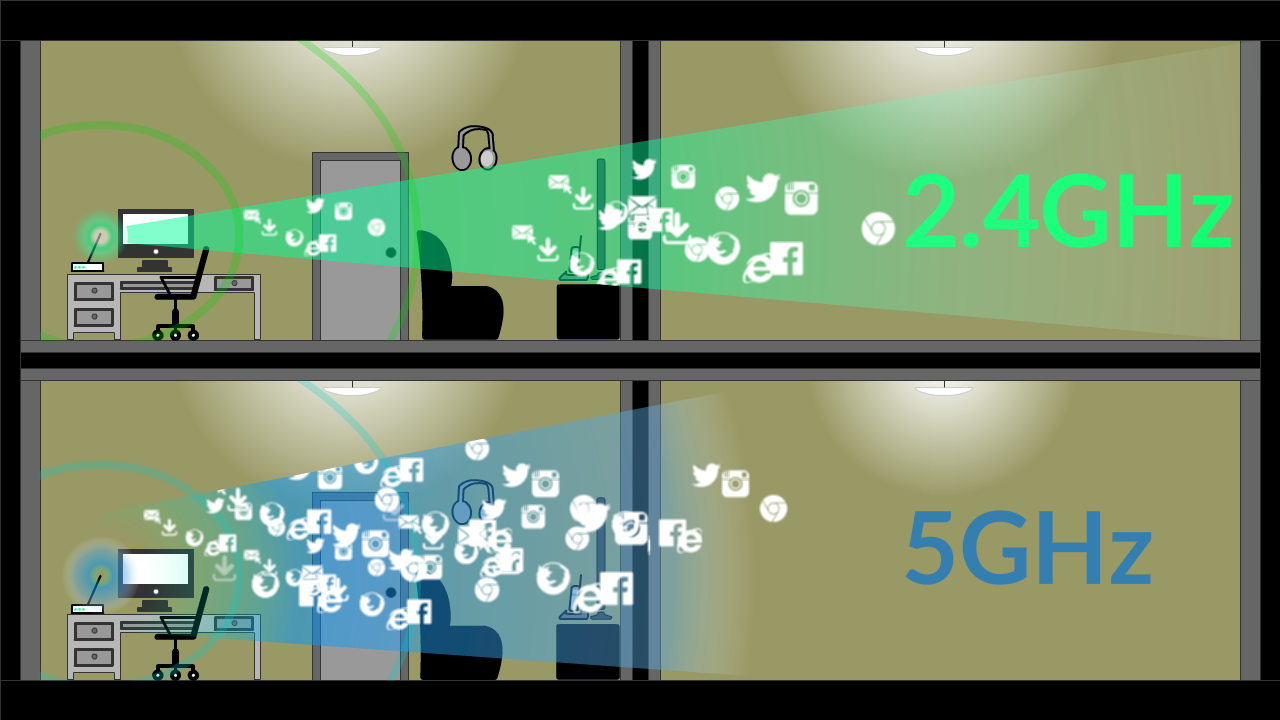
Source (Tecmundo): https://img.ibxk.com.br/2014/08/12/12183931075134.png
So, when a Wi-Fi device connects to the network, there’s a process of exchanging information through electromagnetic waves, making it possible to watch movies, make calls, and browse the internet. Understanding wireless network standards and how they work helps with purchasing equipment, both for corporate and residential use.
Interested in learning how to properly design a wireless network? That could be the topic for our next post. Or you can get in touch with us, since we specialize in high-performance wireless network projects.
Is your operation ready for this?
Talk to ACT and understand, with clarity, where your operation is exposed.
Talk to ACT