
Data Center
Hyperconvergence: What It Is and What Its Advantages Are

Technology for the Datacenter that combines networking, processing, storage, and management.
Today we see convergence in IT infrastructure gaining more and more traction. A few years ago we had dedicated networks for each purpose, for computers, telephony, and CCTV, but these had no communication between them. In recent years, with the popularization of TCP/IP technologies, using a Converged Network has become the main choice when starting a project.
The same technology convergence phenomenon has been happening with the Datacenter. In a not-too-distant past, working with processing, networking, and storage separately (the traditional model) was considered the most robust and secure way to operate. This model, still widely used, is extremely dependent on Hardware. Since nothing in computing stays still for very long, the current advance is coming from the Software layer, making infrastructure less dependent on Hardware compared to the traditional model.
To make each model’s dependencies clearer, we have the image below, which shows the technological transition we went through to arrive at the Hyperconverged model. Through it, it’s possible to see how points of failure are reduced with this technology.
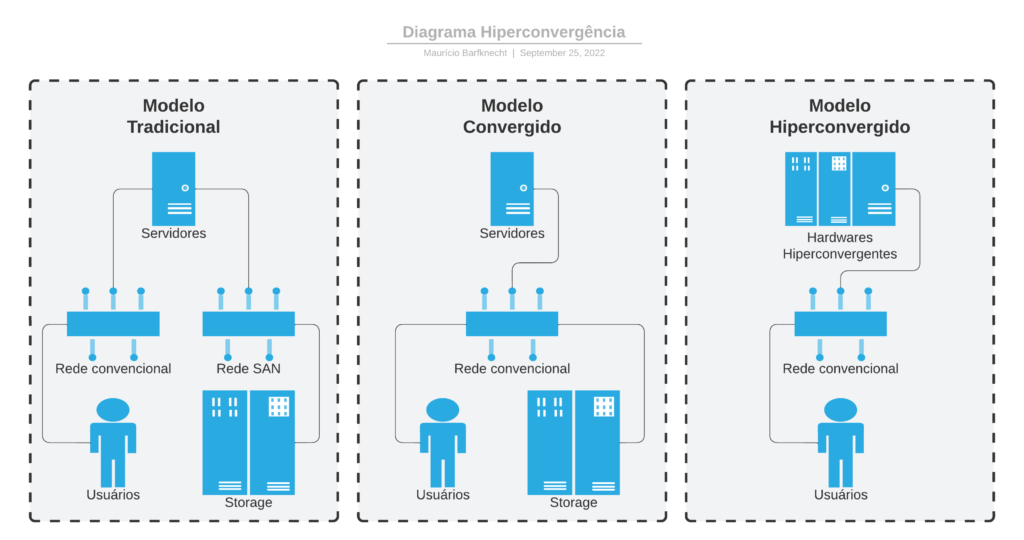
Putting the model into practice:
You might be wondering: but wasn’t the old model more robust? The answer is: it depends. In the old model, due to its dependency on Hardware, even with all the redundancy you could possibly have, the number of failure points increased and scalability decreased. As a simple example, when it came time to grow the Cluster, you were highly tied to the Storage technology chosen at the start of the project, along with its capacity limitations. This dependency doesn’t exist in the Hyperconverged model, where adding a new node to the Cluster only depends on the Hyperconvergence technology being compatible with what’s already used on the other nodes.
Another very common question when talking about this new model is about redundancy itself, since this entire Datacenter structure is tied to just one piece of Hardware. So it’s worth remembering that to have a level of redundancy, a minimum node quorum is recommended, which for most technologies is three, so that if one fails, the others can take over without causing major impact to the user. A good example of the scalability and robustness of the Hyperconverged model is the fact that today the largest public Cloud companies operate on this model due to the sector’s ongoing growth, each with its own hyperconvergence technology, but always following the paradigms of the model mentioned above.
At ACT Tecnologia we implement Open-source and proprietary Hyperconvergence solutions that bring this robustness to our clients, with high scalability and the ability to integrate with public Clouds such as Amazon Web Services, Google Cloud Platform, and Microsoft Azure. Hybrid solutions that combine on-premises and Cloud scenarios make the whole setup even more scalable and resilient.
Is your operation ready for this?
Talk to ACT and understand, with clarity, where your operation is exposed.
Talk to ACT