
Backup: Get to Know the Three Types
Full, Incremental, and Differential
It’s not uncommon to come across organizations, most often small ones, that don’t have or don’t know about their data backup routines.
This usually happens due to a lack of awareness about the importance of this tool, which provides security for information. And it’s often only after some kind of data loss incident that people start to worry about the subject.
Having a backup strategy is a task that should be taken seriously. And for that, you need to know the right tools and methods for each scenario.
Types of Backup
Full Backup
We call it a Full Backup when it’s a complete copy of all stored data, regardless of whether any changes were made to it or not. This means there will be several identical copies of the same file. As a result, more storage space will be needed, and the process’s execution time can be quite long, depending on the volume of data copied.
With that in mind, as a way to get around these problems, we have incremental and differential backups.
Incremental Backup
With Incremental Backup, each routine only copies files that have changed since the last backup, whether that was a full or incremental one. This way, less storage space is used and it takes less time to run.
However, when it’s time to do a full restore of the data, all backup fragments will need to be put back together, which can be more laborious.
Differential Backup
Differential Backup, on the other hand, compares each routine against the last full backup, copying only the information that’s changed since then. Although it generates some data duplication, the advantage of this method lies in the restore process. To fully recover the data, you’ll only need the last full backup and the last differential backup fragment performed.
It’s worth noting that, regardless of the type of backup chosen, at least one full copy of the data is required, meaning the full backup needs to be run at least once.
Besides paying attention to the types of Backup, there are other factors that should be considered when deciding how it will be performed, such as the best times to run it and where to store it, for example.
Still unsure about the best backup strategy for your organization? Get in touch with ACT Tecnologia. We have a specialized team ready to meet your needs.
Hyperconvergence: What It Is and What Its Advantages Are
Technology for the Datacenter that combines networking, processing, storage, and management.
Today we see convergence in IT infrastructure gaining more and more traction. A few years ago we had dedicated networks for each purpose, for computers, telephony, and CCTV, but these had no communication between them. In recent years, with the popularization of TCP/IP technologies, using a Converged Network has become the main choice when starting a project.
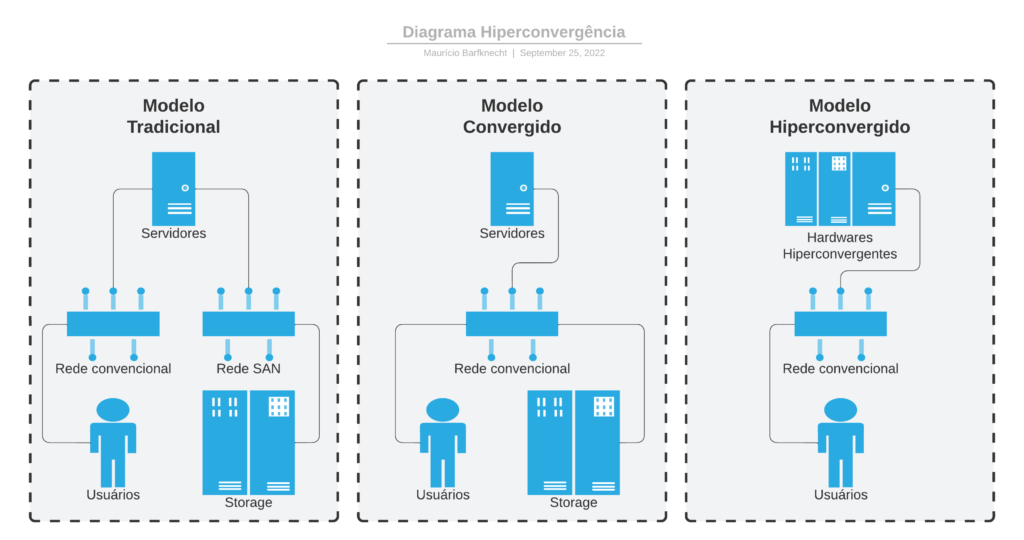
The same technology convergence phenomenon has been happening with the Datacenter. In a not-too-distant past, working with processing, networking, and storage separately (the traditional model) was considered the most robust and secure way to operate. This model, still widely used, is extremely dependent on Hardware. Since nothing in computing stays still for very long, the current advance is coming from the Software layer, making infrastructure less dependent on Hardware compared to the traditional model.
To make each model’s dependencies clearer, we have the image below, which shows the technological transition we went through to arrive at the Hyperconverged model. Through it, it’s possible to see how points of failure are reduced with this technology.
Putting the model into practice:
You might be wondering: but wasn’t the old model more robust? The answer is: it depends. In the old model, due to its dependency on Hardware, even with all the redundancy you could possibly have, the number of failure points increased and scalability decreased. As a simple example, when it came time to grow the Cluster, you were highly tied to the Storage technology chosen at the start of the project, along with its capacity limitations. This dependency doesn’t exist in the Hyperconverged model, where adding a new node to the Cluster only depends on the Hyperconvergence technology being compatible with what’s already used on the other nodes.
Another very common question when talking about this new model is about redundancy itself, since this entire Datacenter structure is tied to just one piece of Hardware. So it’s worth remembering that to have a level of redundancy, a minimum node quorum is recommended, which for most technologies is three, so that if one fails, the others can take over without causing major impact to the user. A good example of the scalability and robustness of the Hyperconverged model is the fact that today the largest public Cloud companies operate on this model due to the sector’s ongoing growth, each with its own hyperconvergence technology, but always following the paradigms of the model mentioned above.
At ACT Tecnologia we implement Open-source and proprietary Hyperconvergence solutions that bring this robustness to our clients, with high scalability and the ability to integrate with public Clouds such as Amazon Web Services, Google Cloud Platform, and Microsoft Azure. Hybrid solutions that combine on-premises and Cloud scenarios make the whole setup even more scalable and resilient.